Direct in previs
Establish composition, action and camera timing. The technical colours identify objects; they do not define the finished look.
Режиссёр и автор
Can the image change
without losing the direction?
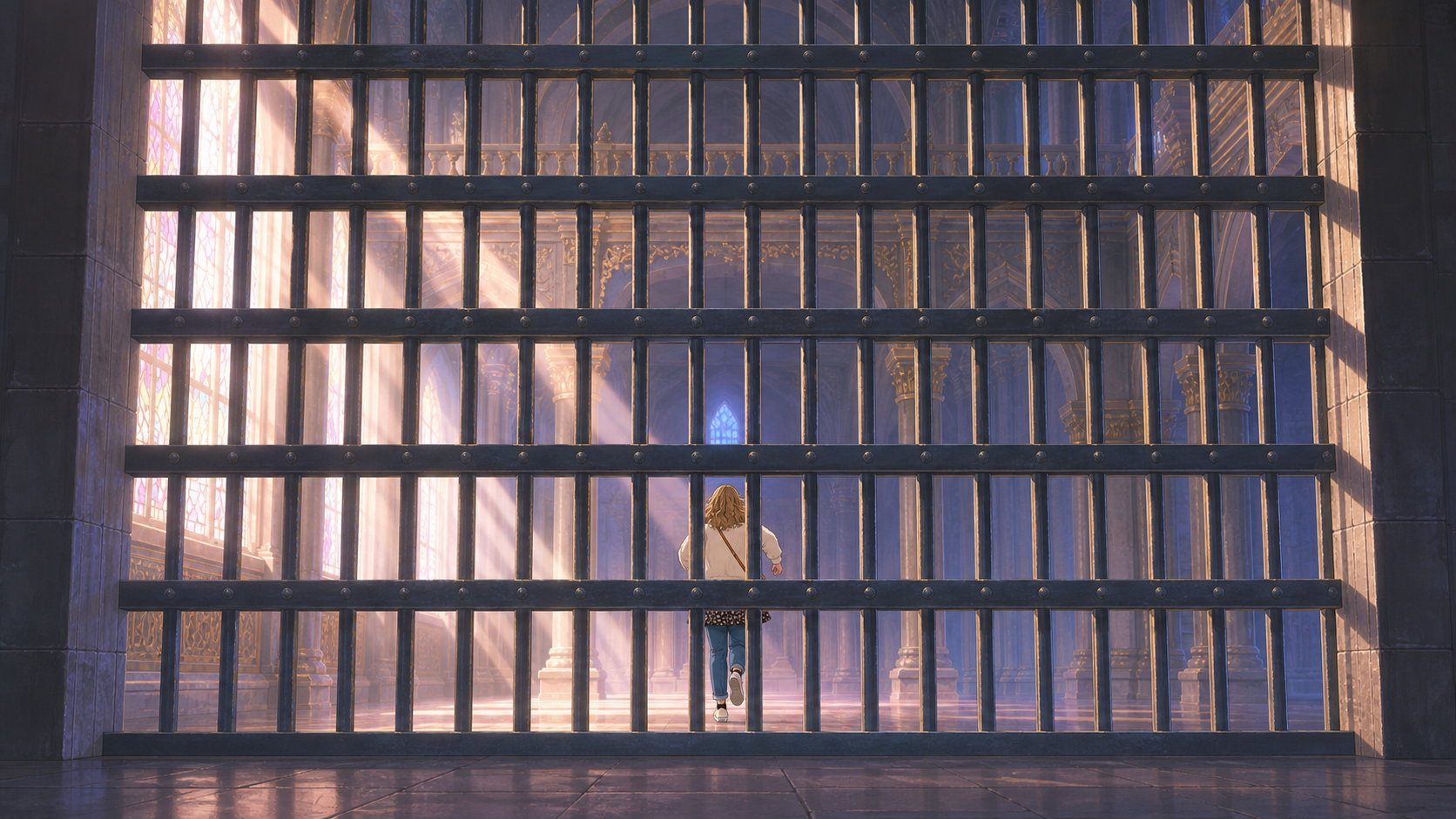
A frightened woman runs through a room and passes under a descending gate. The previs establishes framing, camera movement, character action and gate timing.
I tested whether those decisions could carry into AI video while changing lighting, materials, style, effects and the character. The goal was continuity—not simply a convincing still image.
This is an independent study, not a commissioned campaign. Even successful takes retain differences in pose and fine geometry.
Establish composition, action and camera timing. The technical colours identify objects; they do not define the finished look.
Develop opening and closing frames for character identity, lighting, palette and materials.
Use the video as the primary motion reference. Review the full sequence, then refine ambiguous or conflicting inputs.
Cold graphite materials and natural character detail. Strong staging correspondence, with small geometric differences.
A reference-led anime treatment, developed with Your Name references. The scene becomes a decorated castle: broad staging carries over, but the environment is deliberately reinterpreted.
Technical markers become orange-red light pulses. The broad action remains readable; exact shot-by-shot transfer and impact behaviour still require review.
An Arcane-inspired direction brings a painted treatment to the scene. This take remains closer to painterly realism than fully graphic animation.
A male character replaces the heroine in the cold, realistic environment. The broad action sequence survives; individual poses are not identical to the previs.
Green cylinders specify the shots. Their technical colour is not the intended final colour. Pulses originate behind the heroine and travel in her direction of movement.
These developed frames establish the intended anime appearance. The castle treatment adds architectural decoration; it is not a claim of identical environmental detail.

Observed: an early turn and changes in camera framing and action.
Response: return to a reference-led prompt without a second-by-second rewrite of the motion. The comparison supports this approach, but does not isolate prompting as the only cause.
Observed: the shot starts from behind; the environment is reinterpreted and the gate action loses its intended context.
Response: supply clear visual anchors and make the mannequin’s facing direction readable. Not every video-only test failed in the same way.
Refining faces and materials in still images helped define the target, but generated footage could reintroduce noisy surfaces and unstable detail. A clean start frame is an input improvement, not a guarantee of clean textures throughout the shot.
In these tests, image-led setups made the style more predictable than text-only direction.
A faceless mannequin leaves front-versus-back orientation ambiguous. A readable face or directional marker can help clarify it.
The simpler reference-led prompt worked better in our sequence than competing, detailed timing instructions. This is an observation, not a proven universal rule.
Gate timing, body proportions, material stability and invented background details still need checking.
They do not prove exact geometric reproduction, a universal success rate or guaranteed savings. Successful Recreate runs do not, by themselves, establish that the service fixes the random seed.
One video reference for staging. Two image references for appearance. A four-second generation, followed by comparison against the original shot.
This is the archived realistic baseline used in the study—not a universal template. “Exactly” describes the requested behaviour, not a measured result.
Use @[Video 1](video_1) as the primary source of truth for the entire shot. Reproduce its
single continuous action exactly, including the framing, approved 35mm
perspective, camera path, camera timing, character body motion, character
scale, architecture, object placement, gate layout, gate position and gate
animation. Do not reinterpret or improve the staging.

Use @[Image 1](image_1) as the exact opening-frame appearance and @[Image 2](image_2) as the exact
last-frame appearance. Use these two images only for the woman's identity,
fuller body type, ordinary modern clothing, hair, lighting, color palette,
materials and atmosphere. Do not use their geometry to override @[Video 1](video_1).

The frightened fuller-built young woman has loose wavy blonde/light-brown
hair and wears a cream knitted cardigan, a dark floral tunic or dress, blue
jeans, white sneakers and a tan crossbody bag. Preserve her identity, body
shape and clothing throughout. Reproduce her exact awkward running motion and
timing from @[Video 1](video_1) without reinterpretation.

Preserve the exact room architecture and gate geometry from @[Video 1](video_1).
The interior has the same clean, monumental Harkonnen-inspired material
language established most clearly in @[Image 2](image_2): heavy smooth
blackened satin-steel gate bars and crossbeams, large quiet matte graphite
architectural panels, and a dry honed dark-basalt floor with soft broad
reflections. Cold graphite and steel-gray palette, restrained cyan-white
practical lighting, deep detailed shadows and natural highlight roll-off. Keep
every material temporally stable and physically coherent as the camera moves:
no crawling patterns, texture swimming, flickering roughness, random grunge,
crystalline or cloudy metal, wet patches or procedural noise. Keep natural
skin and ordinary clothing readable.

One continuous shot. No cuts, transitions or montage. No new camera movement,
zoom, lens change, reframing, slow motion or handheld shake beyond @[Video 1](video_1).
No new architecture, objects or people. No sci-fi costume. No identity,
body-shape or gate redesign. No text, subtitles or watermark.
Tools: Autodesk Maya for previs; image generation and refinement; Seedance through Higgsfield for video; side-by-side review. Film and animation names identify visual references, not affiliation or endorsement.
AI can extend a directed shot.
Direction still means deciding what to keep, what to correct and when to try again.
The strongest results preserved the broad staging while allowing substantial changes in appearance. Fine geometry, body proportions, material stability and repeatability remained areas for supervision. These are findings from one sequence, not a benchmark of the model.